Redbreast Whiskey: The Master's Atelier
Project Type
Immersive Whiskey Launch Experience
Medium
Experiential & Digital
Tools
Blender, Figma, HTML, CSS
Team
Group
The Core Challenge
How can we launch the exclusive Redbreast Mizunara Edition at the Osaka Expo 2025 through an immersive experience that bridges Irish heritage with Japanese craftsmanship?
Research & Insights
The project began with a clear brief: design a launch experience for the Redbreast Mizunara Edition at the Ireland Pavilion of the Osaka Expo 2025. Rather than defaulting to a conventional product showcase, the team grounded the concept in a dual cultural identity, the heritage-led craftsmanship of Redbreast's Irish distillery tradition, and the rarity of Japanese Mizunara Osaka.
The site itself shaped our thinking early on. The Ireland Pavilion offered a 20m × 20m enclosed space with ceiling heights of up to 20 metres. This is an environment that allowed for controlled lighting, spatial audio, and directed scent. This was not an open festival floor, it was a stage. That enclosure became a design asset rather than a constraint.
To understand who we were designing for, the team identified four core audience personas: whiskey connoisseurs seeking craft and authenticity, luxury lifestyle visitors drawn to aesthetics and storytelling, press and trade guests focused on brand narrative, and first-time discoverers looking for an accessible but memorable entry point. The experience needed to work meaningfully across all four.
Industry references, including The Macallan's Gallery 12 and Jameson's Lightscape experience, were studied to understand how premium spirits brands use space, sensory layering, and personal narrative to build lasting emotional connections. Technologies explored in this phase included WebAR, projection mapping, NFC tagging, spatial audio, and scent diffusion.
Concept Development
Three distinct directions were developed and presented for peer review, each approaching the Ireland–Japan cultural fusion from a different angle.
A Taste Through Culture
Proposed a large-scale environmental experience, using WebAR and projection mapping to dissolve the pavilion walls and transport visitors between the misty forests of Hokkaido and the Midleton Distillery in Cork. AI-guided storytelling, spatial audio, and scent diffusers created a passive but immersive atmosphere.
The Living Forest
Took a minimalist, discovery-led approach. Visitors entered a near-dark room filled with suspended Mizunara oak staves, scanning them via WebAR to reveal a digital robin's journey from Ireland to Japan. A pre-experience quiz shaped each visitor's individual narrative path.
The Master's Atelier
Proposed a workshop-bar hybrid where visitors became active participants. A voice-responsive AI Master Blender, computer-vision tasting tables, and live laser-engraving stations combined to turn each bottle into a unique collaboration between guest, blender, and nature.
Why We Chose The Master's Atelier
Peer feedback was decisive. The AR-first concepts, while visually compelling, raised concerns about passive engagement. Visitors could get distracted by their phones rather than be present in the space. The Living Forest was praised for its intimacy but flagged for a potentially confusing flow in a high-footfall expo environment.
The Master's Atelier was voted the strongest concept because it turned the visitor into an active participant rather than a spectator. It offered the clearest thematic coherence, treating each person's journey as a unique collaboration, and provided a practical spatial sequencing framework that could be realistically executed within the pavilion's footprint. The personalised physical keepsake created a lasting brand connection that neither of the other concepts achieved.
The Refined Concept: The Four Keepers Experience
The Master's Atelier evolved into a four-stage immersive journey structured around the central metaphor of decoding a secret formula. Visitors are cast as detectives, moving through four sensory "Keepers".
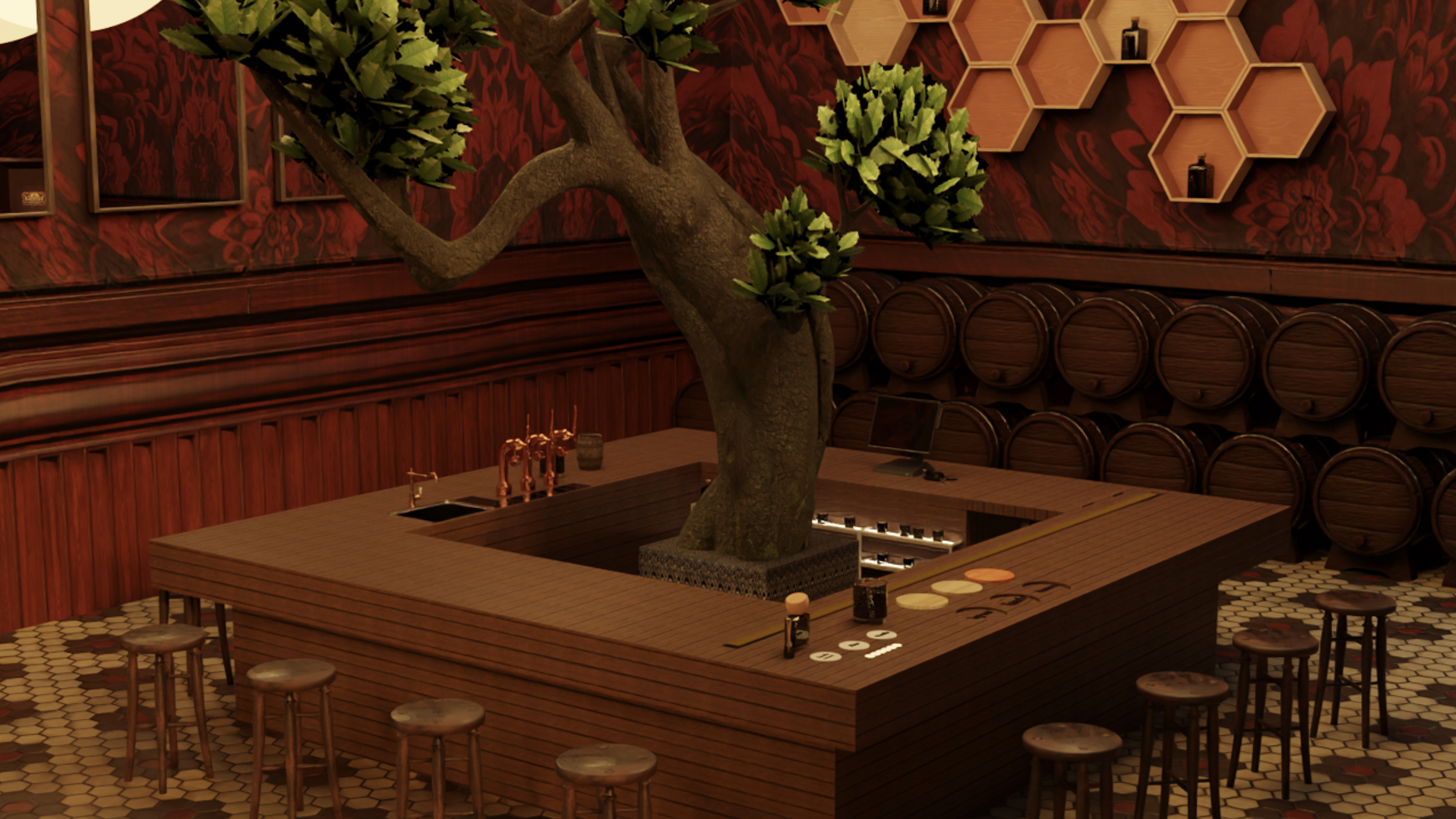
The experience is anchored by a 16-seat bar that physically encloses a large Mizunara oak tree, which serves as the visual and symbolic heart of the pavilion. The bar surface is an embedded interactive touch display overlaid with a wood-grain finish, blending the digital and the tactile seamlessly. Visitors choose their vessel on arrival: either a cask-style mug or a traditional whiskey glass, each embedded with an NFC chip that triggers localised digital responses as the experience progresses.
| Keeper | Sensory Focus | The Interaction |
|---|---|---|
| Keeper I: Sandalwood | Smell | Spray a fragrance and identify the note. Place the vessel on the correct NFC zone to illuminate the bar surface. |
| Keeper II: Oak | Touch | Match three physical wood coasters, each of different grain and weight, to their corresponding hollow shapes cut into the bar surface. |
| Keeper III: Spice | Taste | While tasting the whiskey, drag a digital clock-hand across a pulsing radar interface to mark the dominant tasting sensation. |
| Keeper IV: Orchard Fruit | Personal Reflection | Answer four instinct-based questions. Each answer grows unique digital blossoms on a tree projected onto the bar surface, culminating in a personalised fruit reveal. |
The Interaction Model
The bar surface combines capacitive touch technology with physical NFC sensors to create a seamless blend of tangible and digital interaction. Wood coasters, fragrance bottles, and drinking vessels are moved physically by the visitor, while draggable sliders, radar diagrams, and animated interfaces respond in real time on the "smart" surface beneath them.
The system also tracks live statistics, creating a sense of collective rarity. Visitors are told, for example, that only 12% of that day's visitors share their orchard fruit. This reinforces the limited-edition nature of the Mizunara Edition and makes each result feel genuinely person.
At the close of the experience, guests depart with two physical keepsakes: a personalised whiskey taster certificate and their chosen vessel, both laser-engraved in real time with their name and the date of their visit.
Technical Stack
The hardware stack was designed specifically for the Osaka Expo context, including 100V/60Hz adapted lighting for the Japanese electrical standard. NFC readers are embedded throughout the bar surface, paired with interactive touch displays concealed beneath wood-grain overlays. A live laser engraver operates continuously during the Keeper IV quiz, completing the vessel personalisation in real time.
On the software side, the Keeper interfaces were built as custom HTML/JS prototypes with SVG animations, designed to run directly on the embedded bar displays.
The decision to move away from free-roaming AR towards a communal bar installation was a deliberate one. The bar format fostered social connection between strangers seated alongside one another, created a manageable and predictable visitor flow for a high-capacity expo environment, and ensured staff could facilitate and moderate the experience effectively.
The Responsibilities
As team leader, I was responsible for coordinating the group across every stage of the project, from initial research and concept ideation through to final delivery. This involved setting milestones, reviewing each team member's contributions for quality and completeness, facilitating feedback sessions, and ensuring the overall narrative of the presentation held together cohesively.
Beyond the leadership role, my primary creative contribution was the 3D environment design. I built the pavilion scene in Blender, developing the bar installation in full, including the central Mizunara oak tree, the surrounding 16-seat bar structure, the honeycomb wall shelving, whiskey barrel storage, and the decorative damask wall finish that fused Irish and Japanese visual traditions. I also designed the detailed bar-top layout for Keeper I and Keeper II, modelling the NFC fragrance zones, wood coaster slots, fragrance bottle arrangements, and copper tap fixtures that bring the physical interaction model to life. These renders were central to communicating the final vision, and were used directly in the presentation and video walkthrough.